
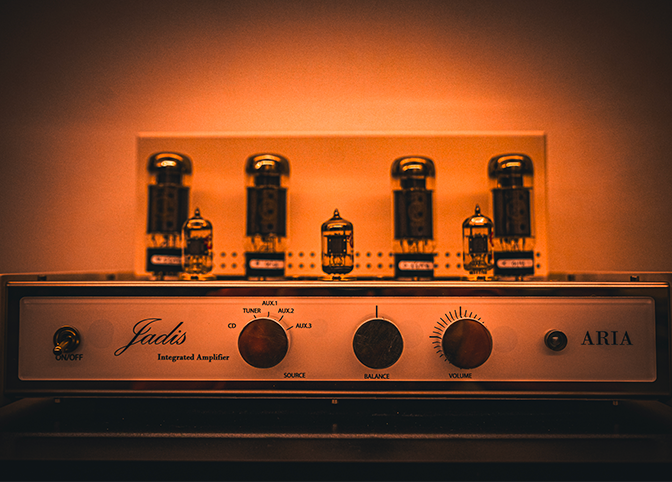
How Does a Tube Amplifier Work?
From the first electrical signal to the loudspeakers, discover how vacuum tubes give music its full scale, texture and life.
Contents
- Introduction
- What is the role of an amplifier?
- How does a vacuum tube amplify the signal?
- The path of music through the amplifier
- The power supply: the energy reserve
- The output transformer
- Single-ended, push-pull and Class A
- Why does it sound so distinctive?
- How to use a tube amplifier correctly
- In summary
With their glowing tubes, imposing transformers and often visible architecture, tube amplifiers have an immediate fascination. Their technology may seem to belong to another era. Yet it remains at the heart of some of the most demanding high-fidelity systems.
Far from being merely an aesthetic or nostalgic choice, the vacuum tube is a component capable of amplifying the smallest variations in a musical signal. But how does an electronic tube transform the delicate signal coming from a source into enough energy to move loudspeaker drivers?
To understand this, let us follow the path of the music step by step through a tube amplifier.
What is the role of an amplifier?
The signal transmitted by a network player, digital-to-analogue converter, CD player or phono preamplifier has a relatively low voltage. It already contains all the information from the recording, but it does not have enough energy to drive loudspeakers directly.
The role of the amplifier is to increase this signal without altering its nuances. It must provide sufficient voltage and current to move the loudspeaker diaphragms while preserving differences in level, rhythm, timbre and the organisation of the soundstage.
This process takes place in several stages. The signal is first selected and adjusted, then amplified in voltage. It is then sent to the power tubes before being matched to the loudspeakers by the output transformers.
An integrated amplifier combines the preamplifier section, volume control and power amplification stage within a single unit. In a system made up of separate components, these functions are divided between a preamplifier and one or more power amplifiers.
How does a vacuum tube amplify the signal?
A vacuum tube is a glass envelope from which the air has been removed. It contains several electrodes, including three fundamental elements: the cathode, the control grid and the anode, also known as the plate.
1. The cathode releases electrons
When the amplifier is switched on, a filament heats the cathode. As a result of this heat, the cathode releases electrons: this is known as thermionic emission. The visible glow inside the tube comes from the heater, but it is not what carries the musical signal.
2. The anode attracts the electrons
The anode is held at a high positive voltage. It attracts the electrons emitted by the cathode, creating an electrical current inside the tube. Everything takes place in a vacuum, with no mechanical contact between the electrodes.
3. The grid controls the current
Positioned between the cathode and the anode, the grid acts as an extremely sensitive control device. The musical signal is applied to it in the form of small variations in voltage. These variations control the flow of electrons passing through the tube.
A small variation at the input can therefore control a much larger variation in the anode circuit. The signal emerges enlarged while retaining its shape and musical information: it has been amplified.
The grid can be compared to a highly precise valve. It does not produce the energy itself; instead, it controls the energy supplied by the power supply in time with the music.
Triode, tetrode or pentode?
A triode has three active electrodes: cathode, grid and anode. Additional grids can be added to improve certain operating characteristics, resulting in a tetrode or pentode.
Common tube types such as the ECC82 or ECC83 are generally used for small-signal amplification. The EL34, KT88, KT120 and KT170 are designed for power output stages. The famous 300B, meanwhile, is a directly heated power triode valued for its simplicity and the finesse of its musical reproduction.
The path of music through the amplifier
Each design has its own particular features, but the signal generally passes through five main stages.
1. Source selection and volume control
The signal enters the amplifier through one of its inputs. The selector chooses the desired source, while the volume control determines the level sent to the following stages. The quality of these components is essential because they operate while the signal is still particularly delicate.
2. Preamplification
The preamplifier tubes first increase the voltage of the signal. They must reveal the finest information while keeping noise and interference to a minimum. It is at this stage that microdetails, ambience and much of the harmonic richness are preserved.
3. Phase splitting and driving
In a push-pull architecture, the signal is divided into two components of opposite phase. The phase-splitter tube performs this separation, while the driver stage provides the amplitude required to control the power tubes.
A single-ended amplifier does not require this division of the signal: the same output tube handles the entire musical waveform.
4. Power amplification
The power tubes give the signal the energy required to drive the loudspeakers. Their operation depends on the chosen circuit, their bias point, the voltage supplied by the power supply and the load presented by the output transformer.
This stage must combine power, speed and stability without losing the nuances created upstream.
5. Matching to the loudspeakers
Vacuum tubes operate at high voltages and with an impedance very different from that of a loudspeaker. The output transformer provides the essential matching between these two worlds. The signal can then reach the speaker terminals, travel through the cables and set the loudspeaker drivers in motion.
The power supply: the amplifier’s energy reserve
The power supply does not process the signal in the same way as an audio stage, but its role is fundamental. It converts the mains electricity and supplies the different voltages required for heating the tubes and operating the audio stages.
After transformation and rectification, the current is filtered by capacitors so that it becomes as stable and quiet as possible. A properly dimensioned power supply allows the amplifier to respond instantly to variations in the music, from the smallest nuances of a voice to the dynamic swings of an orchestra.
An insufficient energy reserve can compress the most demanding passages or introduce noise. Conversely, a generously sized power transformer, carefully designed filtering and rigorous power distribution contribute to quiet operation, stability and a sense of effortless musical reproduction.
The output transformer: a key component
In most high-fidelity tube amplifiers, the output transformer is the final link between the power tubes and the loudspeakers. Its primary role is to match their impedances, but its influence extends far beyond this function.
The quality of its magnetic circuit, the precision of its winding, the insulation between layers and the arrangement of its windings all influence bandwidth, transient response, bass performance, stability and distortion levels.
Designing an excellent output transformer therefore requires a delicate balance: transmitting low frequencies without saturation, preserving high frequencies and handling power while keeping losses to a minimum.
At Jadis, the transformers are designed, hand-wound and manufactured in our workshops in Villedubert, France. They are then encapsulated in a specific resin to improve thermal stability and provide long-lasting protection. Mastery of such a critical component has been part of the Jadis identity since 1983.
Single-ended, push-pull and Class A: what do these terms mean?
These expressions describe the architecture and operating mode of the power output stage. They do not refer to different types of music or tubes.
Single-ended operation
In a single-ended amplifier, one tube — or a group of tubes operating together — handles the entire musical signal. This type of circuit favours a very direct signal path and generally operates in Class A.
It is valued for its coherence, purity of timbre and great finesse, although its output power is often relatively modest. The Jadis SE300B, for example, uses parallel 300B triodes in a single-ended pure Class A architecture.
Push-pull operation
In a push-pull design, the two phases of the signal are handled by complementary branches before being recombined in the output transformer. This approach makes it possible to achieve higher power, reduce certain components of distortion and drive a wider range of loudspeakers.
Class A and Class AB
In Class A, the tubes conduct throughout the entire signal cycle. This operating mode promotes continuity and avoids crossover distortion, at the expense of higher power consumption and heat generation.
In Class AB, the devices share part of the workload as the signal level increases. Efficiency is improved and greater output power can be achieved. However, the operating class alone is not a guarantee of quality: everything depends on how the circuit is designed and implemented.
Bias adjustment
Bias determines the current flowing through the tubes when no signal is present. It establishes their operating point and influences linearity, available power and tube lifespan.
Depending on the amplifier, bias adjustment may be manual, semi-automatic or fully automatic. The manufacturer’s recommendations must always be followed, and only tubes compatible with the amplifier should be used.
Why do tube amplifiers sound so distinctive?
There is no single “tube sound”. Two amplifiers using the same tubes can have very different sonic characters depending on their circuit design, power supply, transformers and settings.
Tube amplifiers are nevertheless often appreciated for the way they reproduce harmonics, microdynamic variations and soundstage depth. Instruments can seem to have greater substance, voices gain presence and notes unfold with a natural sense of continuity.
As they approach their limits, many tube circuits also enter saturation progressively. This smoother transition contributes to a sense of fluidity. However, a high-fidelity amplifier should above all be chosen and matched with suitable loudspeakers so that it operates with sufficient headroom.
The objective is not to add artificial warmth. It is to preserve the rhythm, timbres, silences and emotion contained in the recording. At Jadis, every design choice is made with the aim of achieving a presentation that is alive, natural and transparent.
How to use a tube amplifier correctly
A tube amplifier is straightforward to use, but a few precautions will help preserve its performance and longevity.
- Install it in a well-ventilated area and never cover the tubes or transformers.
- Allow the tubes to reach their operating temperature gradually before critical listening.
- Never touch the tubes while they are hot.
- Switch off and unplug the amplifier before carrying out any external handling, then wait until it has completely cooled down.
- Never open the chassis: dangerous voltages may remain inside even after the amplifier has been switched off.
- Use only tube types specified or approved by the manufacturer.
- Follow the bias adjustment procedure whenever required.
- If you notice unusual noise, abnormal red glowing of a tube or a sudden drop in output level, switch off the amplifier and consult a qualified technician.
Tubes are replaceable components whose lifespan depends on their function, usage and operating point. Periodic replacement is a natural part of owning a tube amplifier designed to provide many years of service.
Jadis advice
A tube amplifier contains very high voltages. Routine maintenance should be limited to the procedures described in the amplifier’s manual. Any internal servicing or change of tube type should be carried out by the manufacturer or a qualified professional.
In summary: from electricity to emotion
- A vacuum tube uses the flow of electrons through a vacuum to amplify the musical signal.
- The control grid transforms small voltage variations into much larger variations in current.
- Preamplifier tubes handle small signals, while power tubes provide the energy required to drive the loudspeakers.
- The power supply acts as the system’s energy reserve and contributes both to low noise and to dynamic performance.
- The output transformer matches the tubes to the loudspeakers and plays a decisive role in the amplifier’s performance.
- Single-ended and push-pull circuits represent two different approaches to amplification.
- Sound quality depends as much on the circuit design and transformers as it does on the choice of tubes.
- Good ventilation and a few simple precautions ensure reliable and long-lasting use.
Inside a tube amplifier, technology is not there to draw attention to itself: it steps aside to bring the music to life.