
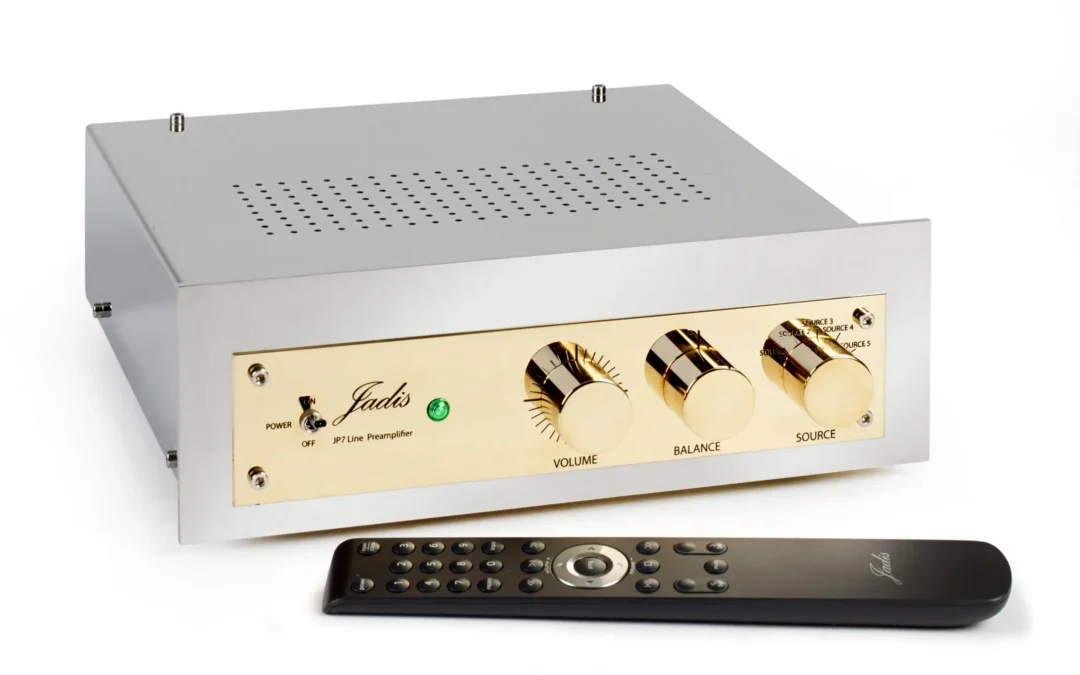
The choice of manual control: preserving signal purity
At Jadis Electronics, every design decision follows one essential requirement: preserving the integrity of the musical signal.
On our preamplifiers with separate power supply, the absence of a remote control is not an oversight, nor a concession to tradition. It is a deliberate technical choice, guided by a simple intention: to avoid any element that could interfere with signal purity.
In a high-fidelity component, volume control is never a minor detail. It sits at the heart of the musical path. This is why, at Jadis, manual control is much more than a habit: it directly contributes to the quality of reproduction.
Volume control: an essential link
In a high-fidelity system, every element crossed by the musical signal matters. Tubes, transformers, capacitors, resistors, internal wiring: nothing is neutral when seeking a lively, natural and transparent reproduction.
Volume control is one of these essential elements. It acts directly on the signal before it is sent to the following stages. Its quality therefore influences precision, dynamics, tonal finesse and the sense of space.
The limits of the traditional potentiometer
In many audio components, volume is controlled by a traditional potentiometer.
Its principle is simple: the signal passes through a moving wiper that rubs against a resistive track, often made of carbon. This solution is widely used, but it has certain limitations when the goal is very high-level sound reproduction.
The contact is made through friction. Over time, this contact can become less stable, create small irregularities and affect the finesse of the musical message.
Signal quality also depends directly on the resistive track being used. In a high-end approach, every material crossed by the signal matters. The smallest compromise can influence transparency, dynamics and tonal richness.
The Jadis solution: a selected resistor ladder
For its reference preamplifiers, Jadis favors a more demanding solution: a 40-position switch combined with a selected resistor ladder.
This architecture allows much stricter control of the signal path. The resistors can be carefully selected according to their material, tolerance and sonic behavior.
Volume is no longer just a practical adjustment. It becomes an integral part of the musical signature of the component.
The 40-position switch: precision and stability
Each position of the switch creates a firm, stable and precise mechanical contact. It is no longer a wiper sliding along a track, but a clearly defined contact point.
When the listener turns the selector, they are not simply increasing or decreasing volume: they are choosing a precise position within an architecture designed to preserve coherence, transparency and the presence of the musical message.
Why not motorize this system?
Motorizing a classic potentiometer is relatively simple. But motorizing a 40-position precision switch involves a very different logic.
Adding remote control usually requires a motor, control circuits and command electronics. In a high-end preamplifier, these elements can introduce unwanted disturbances: electrical noise, high-frequency artifacts and electromagnetic interference.
These phenomena may seem tiny on paper, but in a highly sensitive analog circuit, they can influence the final reproduction.
At Jadis, the objective is precisely the opposite: to create the quietest and most stable conditions possible, so the musical signal can express itself freely.
A design faithful to the Jadis spirit
The choice of manual control is part of a broader philosophy.
Jadis favors short circuits, selected components and an architecture designed around musicality. Where some technical choices add convenience, Jadis prefers to preserve the simplicity of the signal path when it directly serves the listening experience.
This choice is not an opposition to modern comfort. It is an assumed hierarchy: when sonic purity is at stake, musical quality comes before ease of use.
A Jadis preamplifier with separate power supply is not designed as a device to be operated distractedly. It invites attentive listening and a more direct relationship with both the music and the object itself.
Manual control as a listening ritual
Turning the volume selector by hand also restores a physical link with the listening experience.
This simple gesture reminds us that high fidelity is not only about technology. It is an experience. You choose a record, let the electronics warm up, adjust the level, and then the music takes its place.
In this approach, every detail matters. The silence between notes, the stability of the sound image, the texture of voices, the breath of instruments: everything depends on the component’s ability to disappear in front of the music.
Conclusion: a choice for sonic excellence
The absence of remote control on certain Jadis preamplifiers is not a limitation. It is the result of a clear design choice: to preserve signal integrity and avoid any unnecessary source of disturbance.
By favoring a resistor ladder switch rather than a motorized potentiometer, Jadis places musical quality at the heart of the component.
Manual control then becomes the natural extension of this philosophy: a precise, direct and uncompromising gesture, serving a purer, more lifelike reproduction and remaining faithful to musical emotion.