
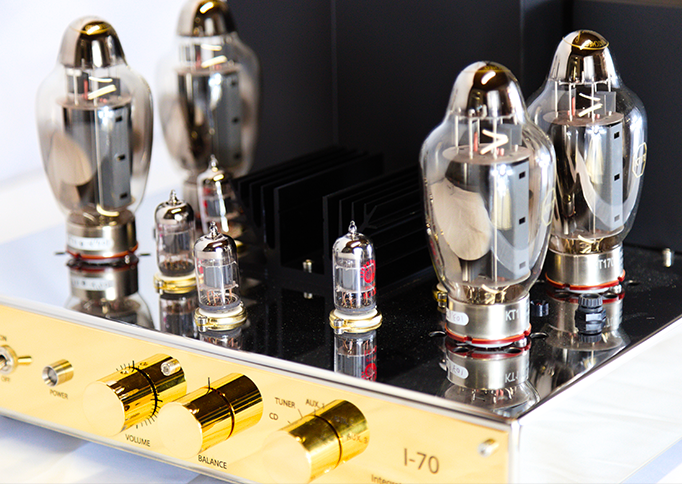
A tube amplifier naturally produces a significant amount of heat. Discover why this happens, what is perfectly normal and which signs genuinely require your attention.
Contents
- Introduction
- Where does the heat come from?
- Why do vacuum tubes get so hot?
- The role of Class A
- Transformers and chassis
- What is perfectly normal?
- Warning signs to watch for
- How to provide proper ventilation
- What should you do if in doubt?
- Summary
The heat generated by a tube amplifier often surprises first-time users. The tubes become extremely hot, the chassis warms up and the transformer covers may become noticeably warm. This can easily be mistaken for overheating.
In most cases, however, it is perfectly normal. A tube amplifier converts a significant proportion of the electrical energy it consumes into heat. This is inherent to the way vacuum tubes operate, particularly when the amplifier is working in Class A.
Heat should not therefore be judged simply by touching the amplifier. It is more useful to observe how the temperature develops, how the tubes behave and whether any other unusual symptoms appear. Here is how to distinguish normal operation from a genuine warning sign.
Where does the heat come from?
An amplifier uses electrical energy to increase the power of the musical signal. Part of this energy is delivered to the loudspeakers, while the remainder is mainly dissipated as heat.
Several components contribute to this heat at the same time:
- the filaments that heat the tube cathodes;
- the internal electrodes that dissipate power during operation;
- resistors and power-supply components;
- the mains transformer;
- the output transformers;
- the chassis, which receives and dissipates some of the heat.
The final operating temperature depends on the number and type of tubes, the circuit architecture, power consumption, duration of use, room temperature and airflow around the amplifier.
There is no single external temperature that can be used to declare every amplifier either “normal” or “too hot”. The most useful reference is the amplifier’s usual behaviour when it is installed in accordance with the manufacturer’s recommendations.
Why do vacuum tubes get so hot?
To operate, a vacuum tube must first heat its cathode. Its filament receives a dedicated electrical supply and raises the cathode to a temperature at which it releases electrons. This process is known as thermionic emission.
These electrons are attracted towards the anode, which operates at a high positive voltage. During this process, the internal elements dissipate a considerable amount of energy. The heat is transferred to the glass envelope and then radiated into the air and towards the chassis.
Power tubes — such as the EL34, KT88, KT120, KT150 and KT170 — generally dissipate far more heat than smaller preamplifier tubes. Their glass envelopes can become much too hot to touch safely. This is normal and does not, by itself, indicate a fault.
Is the orange glow normal?
Yes. The small orange glow visible near the centre or base of a tube generally comes from the filament. It indicates that the heater is operating. It should not be confused with an entire metal plate glowing red, which is an abnormal condition described later in this article.
The role of Class A
Many Jadis amplifiers operate in pure Class A. In this configuration, the power tubes conduct current throughout the complete cycle of the musical signal.
They therefore remain heavily active even when the music is quiet, the volume is very low or no signal is present. This is why a Class A amplifier can produce almost as much heat during quiet listening as it does at a higher playback level.
This continuous operation avoids crossover distortion and encourages a fluid, seamless and immediately available musical presentation. Its natural consequence is lower electrical efficiency and significant heat generation.
Turning down the volume will not necessarily make a Class A amplifier run cooler. Producing heat while idling is part of its operating principle.
Transformers and chassis: the tubes are not the only source of heat
The mains transformer provides the different voltages required by the amplifier. The output transformers match the high impedance of the tubes to the impedance of the loudspeakers. Electrical current flows through all of these transformers, producing electrical and magnetic losses that are converted into heat.
Their covers may therefore become warm during a long listening session. A gradual rise in temperature that eventually stabilises, without unusual smells, noises or changes in sound, is generally normal.
The chassis also contributes to thermal management. It absorbs, distributes and dissipates some of the heat produced by the components. A warm metal surface does not necessarily mean that the amplifier is in difficulty: it may simply be performing its heat-dissipation role.
At Jadis, thermal behaviour is considered from the earliest stages of design. Some mains transformers are deliberately oversized to improve heat dissipation and reduce vibration. On the most powerful models, the power supplies may also be installed in separate chassis to distribute energy and heat more effectively.
What is perfectly normal?
The following signs are generally consistent with the normal operation of a tube amplifier:
- a localised orange glow from the filaments;
- power tubes becoming extremely hot during operation;
- the chassis warming up progressively;
- warm transformer covers after a long listening session;
- significant heat even at low volume from a Class A amplifier;
- a temperature that rises gradually before stabilising;
- a slight increase in the temperature of the listening room during prolonged use.
The appearance of the filaments can vary between tube types. Some are clearly visible, while others are almost entirely hidden by the internal structures. A difference in brightness is therefore not enough, by itself, to conclude that a tube is faulty.
Can you check the temperature by hand?
No. Vacuum tubes can cause burns, and some surfaces may become extremely hot. Touch is neither a reliable measurement nor a safe test. Observe the amplifier’s behaviour and any associated symptoms without placing your hand on the tubes.
Warning signs to watch for
Heat becomes a concern when it is accompanied by a sudden, unusual or localised change. In any of the following situations, switch off the amplifier and seek advice before using it again.
An internal plate begins to glow red
The orange filament must be distinguished from the plate, which is the large, dark metal structure inside the tube. If a significant area of this structure begins to glow red or cherry red, the tube is probably dissipating too much power. This condition, often known as red plating, requires the amplifier to be switched off immediately.
A burning or overheating smell appears
A persistent smell of burning, hot plastic or overheated varnish is not normal. It may indicate that a component, cable or transformer is under excessive thermal stress.
Smoke, sparks or repeated flashes are visible
Any smoke requires the amplifier to be switched off immediately. The same applies to electrical arcing or repeated flashes inside a tube. Do not restart the amplifier several times to see whether the problem disappears.
The sound changes suddenly
A sudden loss of volume, unusual distortion, crackling, a new hum or the loss of one channel may indicate a failing tube or another component fault.
A transformer changes its behaviour
A transformer that suddenly becomes much hotter than usual, begins to vibrate strongly or produces an unfamiliar noise should be inspected by a qualified professional.
A fuse blows repeatedly
A fuse is a protection device. If it blows again after being replaced with the exact type and rating specified by the manufacturer, do not continue. Never install a higher-rated fuse to prevent it from blowing.
How to provide proper ventilation
A correctly installed amplifier relies mainly on natural convection. Cool air reaches the chassis, warms as it passes around the amplifier and then rises away from the unit.
To avoid obstructing this airflow:
- place the amplifier on a flat, stable and heat-resistant surface;
- leave generous free space above and around it, in accordance with its manual;
- do not enclose it inside furniture without both lower and upper ventilation openings;
- do not place another component directly on top of it;
- never cover the tubes or transformers while the amplifier is operating;
- keep it away from curtains, books, fabrics and other heat-sensitive materials;
- avoid direct sunlight, radiators and other sources of heat;
- keep ventilation areas clean and free of dust.
When an amplifier is installed inside hi-fi furniture, hot air must be able to escape through the top rather than becoming trapped. If assisted ventilation is required, it should be quiet, correctly dimensioned and should never replace the clearances specified by the manufacturer.
Room temperature also matters. During summer, the amplifier may reach its thermal equilibrium more quickly and transfer more heat to its surroundings. A properly ventilated room remains the best solution.
What should you do if in doubt?
If the amplifier’s behaviour appears abnormal:
- switch off the amplifier;
- disconnect it from the mains supply;
- do not touch the tubes;
- allow it to cool completely for approximately 30 to 45 minutes;
- do not remove the chassis or attempt any internal work;
- note the symptom, when it occurred and the position of the tube concerned;
- contact your dealer, distributor or the Jadis technical department.
A photograph taken from a safe distance may be helpful if a tube displays an unusual glow. You should also provide the amplifier model, serial number, tube references and the exact circumstances in which the incident occurred.
Jadis advice
A tube amplifier contains extremely high voltages that may remain present after it has been switched off. Any internal work, adjustment not intended for the user or change of tube type must be entrusted to a qualified professional.
Summary: hot does not necessarily mean too hot
- Vacuum tubes must become hot to release the electrons required for amplification.
- A Class A amplifier dissipates a significant amount of heat even at low volume.
- The transformers and chassis also contribute to heat generation and dissipation.
- Extremely hot tubes and a warm chassis can be perfectly normal.
- A glowing red plate, smoke, a burning smell or a sudden change in sound requires the amplifier to be switched off.
- Unrestricted ventilation and installation in accordance with the manual are essential.
- You should never open a tube amplifier yourself.
- If in doubt, switch off the amplifier and consult a qualified professional.
Heat is a natural consequence of tube amplification. When properly controlled, it simply accompanies the music; when its character changes, it should be treated as a warning signal.