EL34, 6CA7, KT88, KT90, KT120, KT150 and KT170: how do they sound different?
Some tubes favour rich midrange tones, while others provide greater firmness, power or control. From the EL34 to the KT170, each output tube has its own particular characteristics. Its final sound, however, always depends on the amplifier in which it is used.
What is the role of output tubes?
In a tube amplifier, the output tubes form the final active stage before the output transformers and loudspeakers. They receive the signal prepared by the preamplifier and driver stages, then provide the energy required to drive the loudspeakers.
Their characteristics influence the available power, dynamic response, bass control and the way the amplifier behaves when it is pushed harder.
A tube capable of handling greater dissipation can, for example, allow the design of an amplifier with more power and dynamic headroom. This does not mean that it will automatically sound more musical or be better suited to every system.
An essential point: the sound of a tube can never be separated from the circuit in which it operates. The power supply, bias setting, driver stages and output transformers all play an equally important role.
The sonic descriptions in this article should therefore be understood as broad tendencies. They help explain the main tube families, but they cannot replace listening to the complete amplifier.
EL34: rich midrange and strong presence
A historic output tubeIntroduced in the 1950s, the EL34 is one of the most famous power pentodes in audio history. It remains highly valued for its ability to give depth to the midrange and reproduce voices with a strong sense of intimacy.
Its balance is often described as warm, but this should not suggest that it lacks precision. In a properly designed amplifier, the EL34 can deliver an open, detailed and remarkably lively presentation.
A dense and expressive midrange
Voices, guitars, strings and acoustic instruments often benefit from a very natural presence and rich harmonic texture.
A sense of intimacy
The EL34 can create the impression that the performer is standing slightly closer to the listener, without artificially pushing the entire soundstage forward.
Its bass is generally supple and nuanced. It may seem less massive than that of a KT88 or KT150, but it can remain beautifully articulate when paired with properly dimensioned transformers.
The EL34 is particularly well suited to vocals, jazz, blues, rock, small classical ensembles and systems in which tonal expression is valued more highly than maximum output power.
Key point: the EL34 generally favours tonal density, expression and midrange presence.
6CA7: a firmer and more energetic presentation
Electrically close to the EL34The 6CA7 is often described as the American equivalent of the EL34. This simplification is convenient, but it does not tell the whole story.
The original European EL34 is a pentode, while many 6CA7 tubes use a beam-tetrode construction. The two references can share similar pin connections and operating conditions without necessarily using the same internal design.
In listening terms, the 6CA7 is often perceived as straighter and firmer than the EL34. Its bass may sound tighter, its attacks more immediate and its midrange slightly less forward.
Greater impact
The 6CA7 can add more weight and definition to percussion, electric bass and rhythm-driven passages.
A straighter presentation
It retains much of the richness associated with the EL34 family while often sounding more structured and slightly less centred on the midrange.
It can therefore be an interesting choice for listeners who enjoy the musicality of the EL34 but want greater firmness, dynamics and control in the lower frequencies.
Key point: the 6CA7 can be regarded as a more energetic and structured alternative to the EL34, although its final character varies according to its construction and manufacturer.
KT88: balance, depth and versatility
A reference in high-fidelity amplificationThe KT88 is one of the most recognised output tubes in the world of high fidelity. It generally provides more power reserve than an EL34 while retaining a rich and fluid musical presentation.
Its bass is often deeper and more firmly controlled. The soundstage gains scale and remains more stable when the orchestration becomes complex.
A particularly complete balance
The KT88 midrange remains rich, but it is generally less forward than that of the EL34. The treble may sound more open, while the bass carries greater weight.
Excellent musical versatility
This combination of substance, depth and control makes the KT88 especially versatile. It can reproduce a jazz trio, a symphonic work, a rock album or an electronic production with equal ease.
Key point: the KT88 often represents the ideal balance between harmonic richness, power and control.
KT90: a more energetic evolution
Between the KT88 and modern high-power tubesThe KT90 was developed to offer greater dissipation capability and output power than many KT88 tubes. It occupies an intermediate position between traditional references and more recent designs such as the KT120 or KT150.
Its character is generally associated with a dynamic, energetic and extended presentation. The bass can gain impact, while attacks may sound more immediate.
Compared with a KT88, it may sound more demonstrative and slightly less smooth. The final result, however, depends heavily on the operating point and the design of the amplifier.
Key point: the KT90 generally provides more energy and headroom than the KT88, with a direct and dynamic presentation.
KT120: greater scale and dynamic headroom
A modern high-power tubeThe KT120 marked an important stage in the development of modern output tubes. Its high dissipation capability allows the design of amplifiers with greater power and headroom than those generally using KT88 tubes.
In listening terms, this additional reserve does not simply mean a higher volume level. It also allows dynamic contrasts to be reproduced with greater ease and improves stability during complex musical passages.
Greater depth
The bass can extend lower and remain more controlled, particularly with demanding loudspeakers.
A larger presentation
The music can unfold more freely without losing the density and tonal richness associated with tube amplification.
The KT120 generally retains a full-bodied midrange, but places it within a wider and more solidly structured soundstage.
Key point: the KT120 increases headroom, scale and depth without abandoning the musical character of the KT family.
KT150: authority, openness and high power
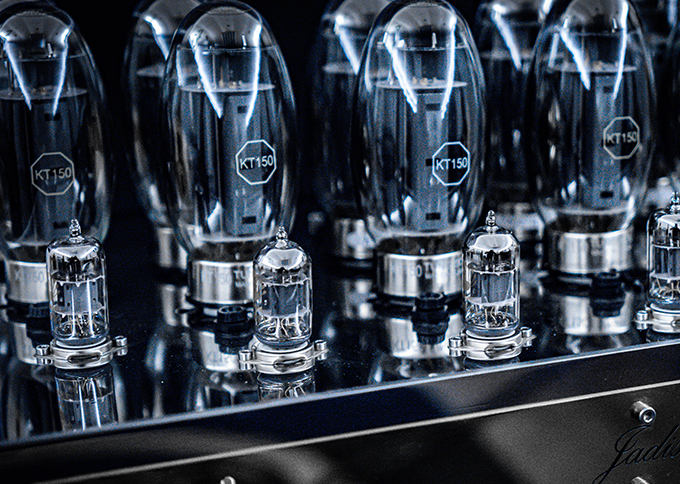
High dissipation capabilityWith its distinctive envelope, the KT150 was designed to operate under particularly demanding conditions. It allows compatible amplifiers to deliver substantial power while retaining excellent dynamic headroom.
Its presentation is often associated with deep bass, an open soundstage and an immediate sense of authority. Attacks are decisive, but can remain highly fluid when the circuit is not designed solely to extract maximum output power.
A large-scale presentation
The KT150 can give large ensembles remarkable scale and stability. It helps preserve instrument separation and the clarity of individual soundstage layers.
Power and finesse are not incompatible
A properly implemented KT150 does not have to sound massive or demonstrative. It can also reproduce micro-details, reverberation and low-level nuances with great delicacy.
Key point: the KT150 combines power, depth and openness, with a particular ability to remain effortless during demanding musical passages.
KT170: maximum extension and control
The most powerful generation in this comparisonThe KT170 continues the development initiated by the KT120 and KT150. Its even greater dissipation capability allows the creation of amplifiers with considerable power reserve.
Its value lies not only in measured output power. It can also provide excellent stability, a very unrestricted dynamic response and greater control over loudspeakers whose impedance or sensitivity places heavy demands on the amplifier.
Deep and articulate bass
The KT170 can deliver an impressive low-frequency foundation without turning the bass into an indistinct mass. Bass lines remain easy to follow and impacts retain their definition.
A stable soundstage
Thanks to its considerable reserve, it can preserve soundstage dimensions and hierarchy even when the volume rises or the recording becomes particularly dense.
As with all high-power tubes, its final character still depends on how it is used. The KT170 should not be considered automatically superior to the KT150, but rather as a tool that enables designers to pursue different objectives.
Key point: the KT170 favours headroom, extension and control while still being capable of preserving the fluidity and harmonic richness expected from a tube amplifier.
EL34, 6CA7, KT88, KT90, KT120, KT150 and KT170: comparison table
| Tube | General sonic tendency | Bass | Midrange | Main strength |
|---|---|---|---|---|
| EL34 | Expressive, warm and intimate | Supple and nuanced | Dense, present and full-bodied | Tonal richness and vocal presence |
| 6CA7 | Straight, energetic and structured | Firmer than the EL34 | Rich, but less forward | Impact and dynamics |
| KT88 | Expansive, balanced and versatile | Deep and structured | Rich and natural | Overall balance |
| KT90 | Energetic, direct and extended | Fast and impactful | Direct and open | Liveliness |
| KT120 | Expansive, powerful and fluid | Deep and authoritative | Full-bodied and spacious | Dynamic headroom |
| KT150 | Open, powerful and majestic | Very deep and controlled | Expansive and transparent | Authority and scale |
| KT170 | Highly extended, stable and controlled | Powerful, articulate and fast | Clear and open | Maximum power and control |
These differences should be understood as broad tendencies. Two amplifiers using the same tube reference can display very different personalities.
The tube manufacturer also plays a role. Internal construction, materials, manufacturing tolerances and matching can all alter the result obtained from the same reference.
↑ Back to contents300B and 845: a different philosophy
The 300B and 845 deserve to be mentioned when discussing the tubes used by Jadis. They should not, however, be compared too directly with the EL34, KT88 or KT150.
The 300B and 845 are directly heated triodes. They are generally used in amplifier architectures and at operating points very different from those of pentodes and beam tetrodes.
Naturalness and transparency
The 300B is renowned for its fluid midrange, harmonic richness and ability to reproduce the finest nuances with a strong sense of naturalness.
Its output power is generally modest. It therefore requires a coherent match with the loudspeakers and listening room.
Scale and luminosity
The 845 makes it possible to obtain greater output power while retaining the particular qualities of directly heated triodes.
It is often associated with a spacious, luminous and fluid presentation combined with excellent authority.
The Jadis I300 and SE300B use the 300B, while the 845NEC is built around the 845 triode. These amplifiers illustrate a different approach: achieving exceptional purity through Class A architectures specifically developed for these tubes.
Key point: the 300B and 845 are not simply lower- or higher-powered alternatives to KT tubes. They represent a different amplifier architecture and a different approach to tube amplification.
Which tube should you choose?
For vocals and tonal richness
The EL34 remains a natural choice when the priority is a present midrange, an intimate presentation and strong expressiveness. The 300B can go even further in terms of naturalness when matched with loudspeakers suited to its output power.
For more impact without losing tonal substance
The 6CA7 often provides an interesting transition between the richness of the EL34 and the firmness of KT-family tubes. The KT90 also offers a dynamic and energetic presentation.
For a versatile system
The KT88 is generally the most balanced choice. It combines tonal richness, bass depth, dynamics and the ability to adapt to a wide variety of musical styles.
For more demanding loudspeakers
The KT120, KT150 and KT170 offer greater power reserve. They help preserve stability and control when the loudspeakers have low sensitivity or a complex impedance curve.
For a very large soundstage
The KT150 and KT170 are particularly interesting when the aim is to achieve a large-scale presentation, very deep bass and substantial dynamic headroom.
The most powerful tube is not automatically the best one. The choice must remain coherent with the loudspeakers, room size, listening level and amplifier design.
Why the tube is only part of the story
It is tempting to attribute the personality of an amplifier solely to the reference printed on its output tubes. In reality, the tube is only one part of a much more complex system.
The final result depends on:
- the chosen circuit topology;
- Class A or Class AB operation;
- single-ended or push-pull configuration;
- the quality and capacity of the power supply;
- the tube bias point;
- the amount of negative feedback;
- the driver stages;
- the output transformers.
The essential role of the output transformer
The output transformer matches the high impedance of the tubes to the much lower impedance of the loudspeakers. It must transmit the entire musical spectrum while handling significant power.
Its geometry, winding pattern, materials and dimensions directly influence bandwidth, phase behaviour, bass control, transparency and the dynamic response of the amplifier.
Two amplifiers using the same tubes can therefore produce radically different results. The tube provides potential. The amplifier architecture determines how that potential is used.
At Jadis, transformers are designed and manufactured in our own workshops. This expertise allows them to be precisely matched to the circuit, the tubes used and the musical objectives of each amplifier.
Can you change tube type in a Jadis amplifier?
Some Jadis amplifiers have been designed to accept several output tube types. Certain models are compatible with multiple references among the EL34, 6CA7, KT88, KT90, KT120 and KT150 families.
This compatibility must never be assumed. Two tubes using the same base may have very different voltages, heater requirements and bias conditions.
Switching from a KT150 to another reference may also require an internal modification on certain amplifiers. The fact that a tube physically fits into the socket does not guarantee correct operation or amplifier safety.
Essential rule: before changing tube type, consult the documentation for the exact amplifier model and version, or contact Jadis and a qualified technician.
When an amplifier is compatible with several tube types, the chosen tubes should also be properly tested and matched. This helps maintain balanced operation and preserve the amplifier’s performance.
↑ Back to contents